Gut Health: Microbiome Influences More Than Digestion
Gut Health: Why The Microbiome Influences Far More Than Digestion
How gut health shapes inflammation, hormones, metabolism, mood, and overall well-being.
Your Gut: Yeah, I’ve been quietly running the show. It’s time we properly introduced ourselves.
By Rahvaunia | Wellness with Rah
Let me guess.
When someone says “gut health,” you think bloating.
Maybe probiotics. Maybe that salad you were absolutely going to eat last Tuesday. (It’s fine. We have good intentions.)
And if your digestion feels okay? You probably figure your gut is fine too.
Totally reasonable. Also — only a small part of the picture.
Here’s the thing nobody mentions in the probiotics aisle: your gut isn’t just a digestion organ. It’s one of the body’s most active communication hubs — running group chats with your immune system, your brain, your hormones, and your metabolism simultaneously. All day. Every day. Without a single complaint about the workload.
So when the gut falls out of balance, the signals don’t always show up where you’d expect.
Fatigue
Brain fog
Skin flare-ups
Mood shifts
Hormone disruption
Symptoms that seem to have absolutely nothing to do with digestion — and yet, here we are, talking about your gut.
Not a coincidence.
“Your gut isn’t just digesting food — it’s running conversations with your entire system.”— Rahvaunia | Wellness with Rah
What Gut Health Actually Means

Gut health refers to the balance and function of the gut microbiome — a vast, living community of bacteria, fungi, and microorganisms that reside primarily in your large intestine.
When the microbiome is balanced and diverse, it helps your body:
•Break down and absorb food
•Produce key nutrients (yes, your gut literally manufactures some of your vitamins)
•Regulate inflammation
•Support immune function
•Communicate with the brain
You’ve probably heard the gut called “the second brain.”
And while your gut isn’t down there scheduling your appointments — it is in constant, bi-directional communication with your actual brain through something called the gut-brain axis.
A real, functioning highway. Traffic runs both ways.
What happens in the gut does not stay in the gut. No Las Vegas vibes here.
Signs Your Gut May Be Out of Balance
Some gut signals are obvious. Others show up wearing a full disguise, and you’d never think to connect them back to digestion.
The ones you’d expect:
•Frequent bloating
•Gas after meals (we’re adults, we can say it)
•Constipation, diarrhea, or the delightful rotation of both
•Food sensitivities that seem to multiply by the season
The ones that tend to fly under the radar:
•Brain fog
•Fatigue that doesn’t improve with rest
•Skin issues — acne, eczema, unexplained rashes
•Mood changes or heightened anxiety
•Frequent illness or slow recovery
Digestive symptoms get all the attention.
But many gut signals show up well outside the digestive tract — which is exactly why gut health gets overlooked as a root contributor to symptoms people have been managing for weeks, months, even years.
Your gut has been trying to tell you something. It just hasn’t been using the words you expected.
The Gut Is Connected to Everything
Okay. This is the section I need you to actually sit with for a moment.
I know “gut health” can start to feel like a wellness buzzword that gets attached to everything.
Tired? Gut health. Anxious? Gut health. Bad hair day? Probably also gut health, honestly.
But here’s the thing — the science actually backs this up.
The gut’s reach across the body is not an exaggeration. It is a communication system. And once you see the connections, you cannot unsee them.
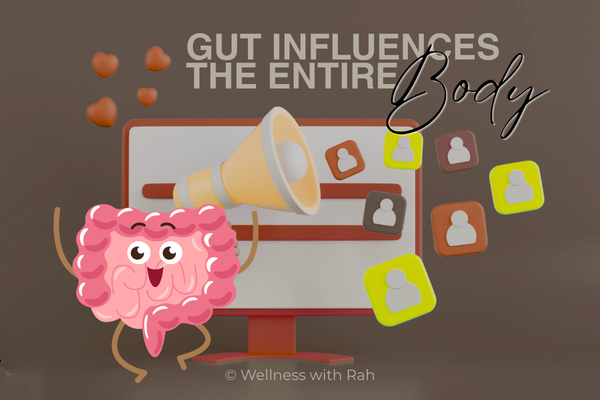
“If your body was a social media platform — your gut would be the Viral Influencer.”— Rahvaunia | Wellness with Rah
And before we go any further — let’s be clear about something:
Your gut is not sitting around plotting against you.
It’s not back there going, “Hmm. How do we make things difficult today?”
Your gut is responding to signals.
What you’re feeding it.
How much stress you’re carrying.
Whether you slept.
Whether your blood sugar has been stable.
It is doing its absolute best with what it’s been given.
When things go sideways, it’s not betrayal. It’s communication.
Here’s what that communication actually looks like across the body:
Gut ↔ Inflammation
A disrupted microbiome can increase inflammatory signaling throughout the body — not just locally in the gut, but systemically. Chronic, low-grade inflammation is a root driver in many of the conditions people struggle with for years without connecting back to gut health.
Gut ↔ Hormones
The gut plays a direct role in metabolizing and regulating hormones — including estrogen. [Gastroenterology Advisor —Haymarket Medical Network]
There is even a specific group of gut bacteria called the estrobolome that helps process estrogen. When this is disrupted, hormone balance can shift. This is why gut health is increasingly part of the conversation around PMS, perimenopause, and hormonal symptoms that feel impossible to pin down.
Gut ↔ Mood
Roughly 90% of the body’s serotonin — the neurotransmitter most associated with mood and wellbeing — is produced in the gut. [National Library of Medicine]
Not the brain — the gut. Through the gut-brain axis, gut microbes influence neurotransmitter production and signaling in ways that directly affect how you feel emotionally. The brain-mood connection is real. It just starts a lot further south than most people realize.
Gut ↔ Immune Health
Approximately 70% of the immune system lives in the gut. [UCLA Health]
Which means gut balance isn’t just a digestive issue — it’s an immune issue. When the microbiome is disrupted, immune responses can become dysregulated. This shows up as increased susceptibility to illness, slower recovery, and in some cases, heightened inflammatory or autoimmune responses.
Gut ↔ Metabolism
Gut microbes directly influence blood sugar regulation, insulin sensitivity, and how the body processes and stores energy. [Weill Cornell Medicine]
Imbalances in the microbiome have been linked to metabolic disruption — which is one reason gut health is increasingly part of the root-cause conversation around weight, energy, and blood sugar instability.
“The gut isn’t working alone. It’s leading a group chat with the rest of the body.”— Rahvaunia | Wellness with Rah
Why Modern Life Challenges Gut Health
Many people assume gut health begins and ends with probiotics.
Take the capsule.
Fix the gut.
Done.
But the microbiome responds to far more than supplements. It responds to the patterns shaping daily life — and modern life, in particular, throws a lot of challenges at it.
•Highly processed diets — low in fiber, high in additives that disrupt microbial diversity
•Chronic stress — directly alters gut motility, permeability, and microbial balance through the gut-brain axis
•Antibiotic use — necessary and sometimes life-saving, but broad-spectrum antibiotics affect beneficial bacteria alongside harmful ones
•Environmental toxins — pesticides, chemicals, and pollutants we encounter regularly can disrupt the microbiome over time
•Poor sleep — circadian rhythm disruption directly affects microbial activity and gut repair
•Blood sugar instability — glucose fluctuations influence the gut environment and microbial composition
Gut health doesn’t exist in isolation.
Blood sugar patterns, stress patterns, and sleep patterns all shape the microbiome. Which is exactly why gut health is one of the pillars we look at inside a root-cause framework — not as a standalone issue, but as part of a larger picture.
The Gut Barrier — And Why It Matters
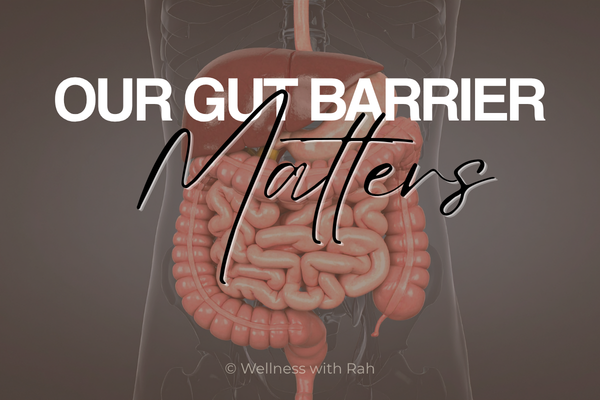
Your gut isn’t just a tube that food passes through. The intestinal lining is a sophisticated, selective barrier — designed to let nutrients into the bloodstream while keeping everything else out.
When that barrier becomes compromised — something sometimes referred to as increased intestinal permeability, or “leaky gut” — particles that shouldn’t pass through can enter circulation and trigger immune responses.
The gut barrier is designed to be selective. It knows what belongs in the bloodstream and what doesn’t. When that selectivity is disrupted, the immune system starts asking a lot of questions — and the answers often show up as inflammation, food sensitivities, or systemic symptoms that are hard to trace back to a single cause.
Contributors to gut barrier disruption include many of the same factors that challenge the microbiome: chronic stress, processed foods, blood sugar instability, environmental exposures, and poor sleep.
Are you starting to see the pattern here?
Gut Health in Root-Cause Wellness
In root-cause wellness, gut health is rarely viewed as a single, isolated issue. It’s almost always part of a larger pattern — one that involves nutrition, blood sugar regulation, inflammation, stress physiology, and sleep.
Which is why investigating gut health means looking beyond digestion.
Inside the R.O.O.T.S. framework, the gut is one of the key pillars I evaluate — not because every symptom is a gut problem, but because gut imbalance has a way of showing up in patterns that span multiple systems. And when we address the gut as part of the whole picture, things tend to shift in ways that feel different from anything a supplement protocol alone could produce.
“The gut thrives on rhythm and diversity — and so does the body it’s supporting.”— Rahvaunia | Wellness with Rah
Foundations That Support Gut Health
Let’s talk about what actually moves the needle — without the gimmicks, the 10-day resets, or the $180 supplement stacks.
The gut responds beautifully to consistency. Not perfection. Consistency.
Fiber Diversity
A variety of plant foods feeds a variety of beneficial microbes. The goal isn’t to eat more of one thing — it’s to eat a wider range of things. Vegetables, fruits, legumes, whole grains, nuts, seeds. Variety is the point.
Blood Sugar Stability
Stable glucose supports microbial balance. Blood sugar spikes and crashes create an environment that favors less beneficial bacteria. Supporting blood sugar rhythm — through consistent meals, fiber, protein, and balanced eating patterns — also supports the gut.
Stress Regulation
Because the gut-brain axis is real, stress directly affects digestion — gut motility, barrier integrity, and microbial composition all shift in response to chronic stress. This isn’t “stress less” advice. It’s an acknowledgment that nervous system support is gut support.
Sleep
Circadian rhythms influence microbial activity. The gut has its own clock — and consistent, restorative sleep supports gut repair, microbial balance, and the overall environment the microbiome needs to thrive.
Movement
Regular movement supports gut motility, circulation, and the diversity of the microbiome. This doesn’t mean intense exercise — consistent, sustainable movement is what the gut (and the rest of the body) actually responds to.
Why Quick-Fix Gut Protocols Often Fall Short
Elimination diets.
Gut resets.
21-day cleanses.
The wellness space is full of gut protocols — and some of them do provide temporary relief.
But here’s what tends to happen: people feel better for a few weeks, then the symptoms creep back. And they’re left wondering what they did wrong.
Usually, they didn’t do anything wrong. They just addressed a symptom without investigating the pattern underneath it.
Eliminating foods or taking supplements can help in the short term. But without understanding the patterns shaping gut health — the stress load, the sleep quality, the blood sugar rhythms, the lifestyle factors — improvements often don’t hold.
The gut is a complex, responsive system. It doesn’t need a harder reset. It needs a more honest investigation.
When Deeper Investigation Helps
Sometimes the foundation work is enough. Food, sleep, stress, movement — when those pieces come into alignment, the gut often responds.
But there are situations where a more thorough investigation is genuinely useful:
•Persistent digestive issues that haven’t resolved with dietary changes
•Unexplained or systemic inflammation
•Hormone imbalances — especially estrogen-related symptoms
•Chronic fatigue that doesn’t improve with rest
•Ongoing food sensitivities that seem to be expanding over time
If your body has been asking questions and you haven’t found satisfying answers yet — that’s often a signal that a deeper look is warranted.
Not because something is catastrophically wrong. But because the pattern hasn’t been fully seen yet.
Where to Start
You don’t need a complete gut overhaul to begin supporting your microbiome.
Small, consistent shifts have a real impact — because the gut responds to daily patterns, not dramatic interventions.
Start here:
•Eat a wider variety of fiber-rich plant foods — aim for diversity, not just quantity
•Support blood sugar balance through consistent, balanced meals
•Slow down at meals — digestion begins before food even reaches the gut
•Start noticing your digestive patterns — when symptoms appear, what triggers them, what helps
Gut health isn’t built overnight.
Let me say that again: gut health isn’t built overnight.
Yes, we are a society that has been trained to want the quick fix, the ‘now’ culture, the instant gratification mindset. Just remember Rome wasn’t built in a day, and neither was the current condition of our guts.
We have some unpacking, unlearning, and adjusting to do… and we can all do it together.
“The more we know. The more we glow!”— Rahvaunia | Wellness with Rah
Gut health is supported through consistent daily habits — the same ones that support your sleep, your stress response, your blood sugar, and your overall health.
Which is kind of the whole point of root-cause wellness.
Everything is connected. The gut is just one of the clearest examples of that.
Ready to Investigate Your Gut Health?
Inside the R.O.O.T.S. program, gut health is one of the key pillars we explore when investigating the root causes of fatigue, inflammation, digestive symptoms, and metabolic imbalance.
Through health history mapping, lifestyle analysis, and personalized strategy, we identify the patterns shaping your gut health — and build a plan that supports lasting improvement. Not a reset. A real investigation.
→ Learn more about the R.O.O.T.S. process
One Last Thing
Your gut is not working against you.
It’s not sitting in there plotting your worst week.
It’s communicating.
Responding to signals.
Doing its absolute best with the environment it’s been given.
“Sometimes the path to feeling better begins in a place most people never think to look.”— Rahvaunia | Wellness with Rah
And when we start listening to those signals — instead of silencing them — the whole picture starts to shift.
The gut isn’t just digesting your food.
It’s communicating with your immune system. Your metabolism. Your brain. Your hormones.
When gut health improves, the effects ripple through the entire body. And that’s the kind of group chat we want our body to be in. Improving and thriving!
With love and intention,
Rah 🌿
Certified Functional Nutritionist | Wellness with Rah