Listen To Your Body: Relearn the Signals
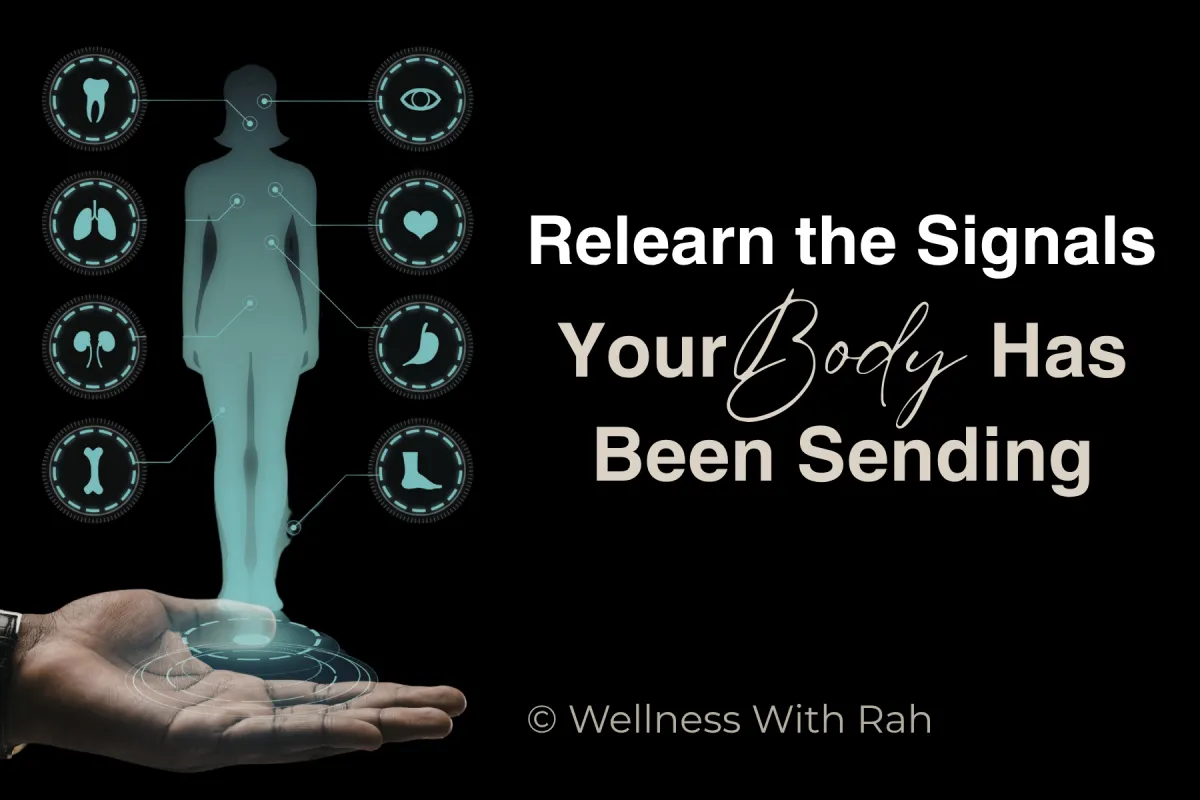
Listening to Your Body: Relearning the Signals Your Body Has Been Sending
Listening to our bodies becomes harder when everyone else is talking louder than our internal signals.
Why body awareness is one of the most overlooked tools in modern health.
By Rahvaunia | Wellness with Rah
Somewhere along the way, many of us stopped trusting our bodies.
Not all at once.
Gradually. Quietly.
In the small moments when we pushed through the fatigue instead of resting. When we silenced the hunger because the timing wasn’t convenient. When we normalized the headache, explained away the bloating, and filed the exhaustion under “just getting older.”
We were taught, in a hundred different ways, to override the signal and keep moving.
And so we did.
But the body didn’t stop talking. It never does.
It just started speaking louder.
Not because it’s dramatic. Not because something is catastrophically wrong. But because it’s been trying to be heard — and it will keep trying, in increasingly creative ways, until we finally pause long enough to listen.
“The body speaks in signals long before it raises its voice.”— Rahvaunia | Wellness with Rah
This article is about learning to hear it again.
My work is built on four beliefs.
01.The body communicates.
Always. Through energy, digestion, sleep, mood, skin, cravings — it is constantly sending information.
02.We listen.
Before we try to correct anything, we pause to understand what the body may be expressing.
03.Symptoms guide us.
They are clues, not the cause. They point toward patterns, imbalances, and stressors operating beneath the surface.
04.Healing requires looking deeper.
What appears to be the problem is often only the outer layer. Together, we gently peel back the layers to find what’s underneath.
Why We Stopped Listening
Modern life doesn’t exactly reward stillness.
It rewards productivity. Output. Speed.
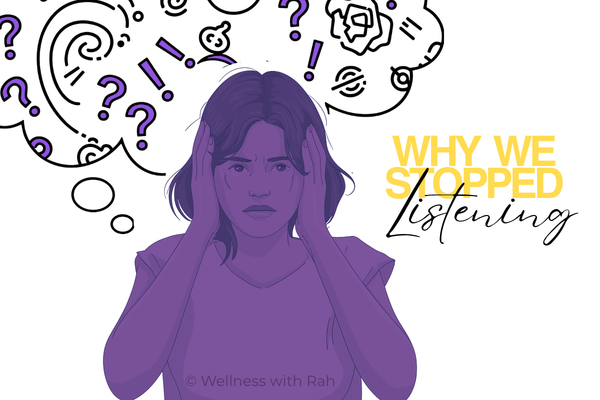
The ability to push through discomfort without slowing down.
Rest gets rebranded as laziness.
Exhaustion gets rebranded as hustle.
And somewhere in that culture, the quiet art of actually paying attention to how we feel gets completely lost.
Health advice, for all its good intentions, often makes this worse. Because most of it tells us what to do — without ever teaching us how to observe.
Eat this. Avoid that. Take this supplement. Follow this protocol.
But the body rarely operates according to someone else’s checklist. It operates according to its own language. Its own rhythms. Its own very particular way of asking for what it needs.
And if we’ve never been taught to listen for that — we’ll spend a long-time following instructions that were never written for us.
The Body Communicates in Patterns
The body is always communicating.
·Energy dips
·Cravings
·Digestive shifts
·Sleep that won’t come or won’t last
·Moods that arrive without explanation
·Skin that flares when life gets overwhelming
These are not random inconveniences.
They are patterns of communication — the body’s way of leaving breadcrumbs toward something that needs attention.
The body rarely whispers just once.
It repeats itself.
It is patient and persistent in a way that most of us are not. It will send the same message in the same way, day after day, waiting for us to finally notice.
And here’s what I want you to consider:
Some of us have been receiving those messages for so long — the afternoon energy crash, the bloating after certain foods, the sleep that never feels like enough — that we’ve stitched them together into something that just feels like life. Pattern by pattern, symptom by symptom, we’ve built ourselves a quilt of “normal.”
And quilts are cozy. Quilts are comfortable. Quilts are familiar.
But comfortable and thriving are not the same thing.
So let’s gently roll out of the burrito quilt, shall we? Not because something is wrong with you. But because you deserve to know what it feels like when the signals are actually being heard.
Symptoms Are Communication, Not the Enemy
Here’s a reframe that changes everything:
Symptoms are not problems to eliminate. They are information to understand.
When fatigue shows up persistently, it may be pointing toward blood sugar instability. Sleep disruption. Stress overload. A nutrient need, the body hasn’t been able to meet. Fatigue isn’t the problem — it’s the signal pointing toward the problem.
When digestion becomes uncomfortable after meals, it may be communicating food intolerances, gut imbalance, or a nervous system that’s been in overdrive for too long. The discomfort is the message. Not the diagnosis.
Listening doesn’t mean ignoring symptoms or waiting them out. It means getting genuinely curious about what they’re pointing toward — rather than rushing to silence them before they’ve had a chance to speak.
“Symptoms are clues, not conclusions. They guide us toward the story underneath.”— Rahvaunia | Wellness with Rah
The Noise That Makes Listening Hard
I want to acknowledge something, because I think it’s important:
Listening to your body is genuinely hard to do right now.
Not because you’re not capable. But because the noise is relentless.
Social media experts who contradict each other daily.
Wellness trends that arrive with urgency and disappear in three months.
Protocols built for someone else’s body, sold as universal truth.
One week, carbs are the villain. The next week, carbs are essential. Cut dairy. No, add it back. Cold plunge. No, sauna. Intermittent fast. No, never skip breakfast.
Somewhere in all of that noise, it becomes very easy to stop trusting your own experience. To outsource your body’s wisdom to whoever is speaking loudest.
And that’s exactly where things start to unravel.
“Listening to our bodies becomes harder when everyone else is talking louder than our internal signals.”— Rahvaunia | Wellness with Rah
Your body’s signal was never the problem. The volume of everything else is.
Rebuilding Body Awareness
Coming back to the body doesn’t require a dramatic overhaul. It requires curiosity. Small moments of attention, practiced consistently, until they become second nature.
It might look like:
•Noticing how you feel after meals — not judging what you ate, but observing how your body responded
•Paying attention to when energy rises or dips during the day — and what was happening before it shifted
•Noticing what improves your sleep, and what disrupts it
•Observing which situations leave you feeling depleted, and which leave you feeling restored
•Pausing when a symptom appears, instead of immediately pushing past it
The goal is not to hyper-analyze every sensation until your body becomes a full-time research project.
The goal is simply to shift from disconnected to curious. From “I don’t know why I feel this way” to “I wonder what this might be telling me.”
That shift — small as it sounds — is the beginning of everything.
Curiosity Instead of Control
A lot of us come to wellness through control.
Rigid meal plans.
Strict elimination protocols.
Fear of doing something “wrong.”
A constant negotiation between what we want and what we think we should be doing.
Health becomes a discipline. A performance. Something we’re either succeeding or failing at.
But control and curiosity are very different orientations toward the body.
Control says: I need to manage this.
Curiosity says: I wonder what this is about.
Control shuts the conversation down. Curiosity opens it.
And it’s curiosity — not discipline — that actually creates learning. Because when we approach the body with genuine openness, we start to see things we couldn’t see when we were too busy managing.
“Curiosity opens the door to understanding. Control often shuts it.”— Rahvaunia | Wellness with Rah
The body responds to being heard. Not to being managed.
Listening Doesn’t Mean Doing It Alone
Body awareness is one of the most powerful tools available to us. And there is absolutely work each of us can do on our own — noticing patterns, getting curious, slowing down enough to actually hear what’s happening.
But sometimes the signals are subtle. Sometimes they’re confusing or contradictory. Sometimes multiple systems are involved, and what looks like one pattern is actually three patterns overlapping. And sometimes we’re simply too close to our own experience to see it clearly.
That’s not a failure of awareness. That’s just the nature of being human.
Working with a practitioner who knows how to listen — not just to symptoms, but to the full picture of who you are and how your body has been communicating — can bring a clarity that’s genuinely hard to find on your own.
Guidance doesn’t replace your body’s wisdom. It helps you interpret it.
The Role of Root-Cause Investigation
My work begins by listening.
When we slow down enough to actually hear what the body is saying, it tends to raise deeper questions.
Why does energy crash every single afternoon, regardless of how much sleep I got?
Why do certain foods cause reactions now that never bothered me before?
Why do symptoms appear in cycles — better for a while, then back again?
These questions deserve more than a quick answer. They deserve investigation.
Root-cause work is the practice of following those questions deeper — looking at the patterns, the timelines, the systems involved, and the lifestyle factors shaping the picture — until the body’s communication starts to make sense. Not just as a list of symptoms, but as a story. One with a beginning, a middle, and a path forward.
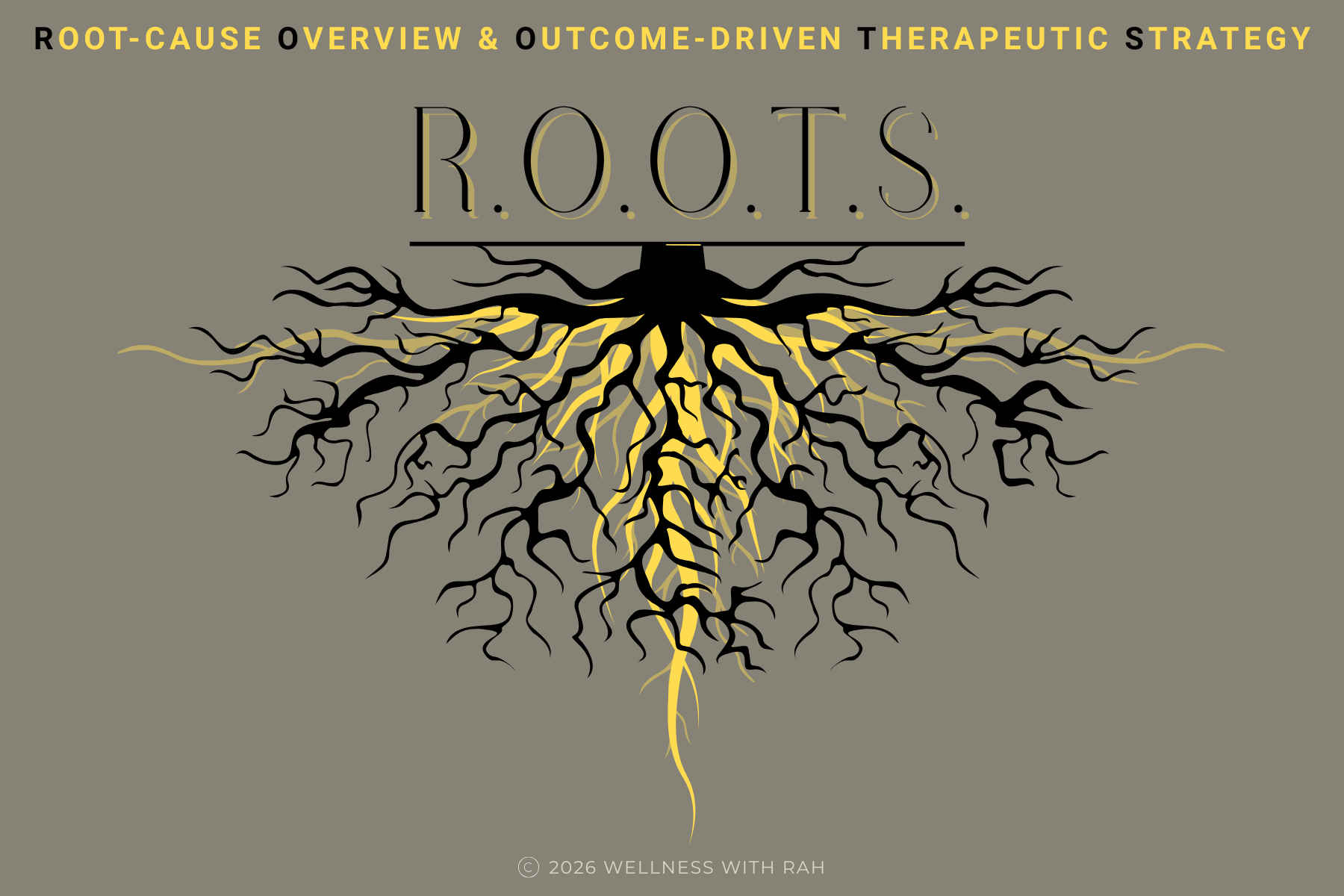
Inside the R.O.O.T.S. framework, we don’t start by fixing. We start by listening. And what we hear in that listening shapes everything that comes after.
Small Ways to Start Listening Today
You don’t need to overhaul your life to begin. Listening is a practice — and like any practice, it starts small and deepens over time.
•Pause before rushing through fatigue. Ask: what is my body asking for right now?
•Notice hunger cues before they become urgency — and notice what happens when you honor them
•Keep a simple log of sleep, energy, and digestion for a week — not to judge, just to observe
•After a meal that leaves you feeling off, get curious instead of guilty
•Name what you’re feeling in your body, not just your mind, at least once a day
These aren’t protocols.
They’re invitations. To slow down. To notice. To remember that the body has always been speaking — and that learning to hear it is one of the most profound things we can do for our health.
“The body is not the enemy. It’s the messenger.”— Rahvaunia | Wellness with Rah
Trust Can Be Rebuilt
Many people arrive at this work feeling deeply disconnected from their bodies.
Years of overriding signals will do that. So will years of being told your experience isn’t valid, your labs are normal, your symptoms are stress, your body is just aging.
If that’s where you are — I want you to know something:
The body didn’t stop communicating. It never does. The channel is still open.
Awareness can return. Trust can be rebuilt.
Not all at once — but gradually, in the same quiet way it was lost. One moment of attention at a time. One signal acknowledged instead of pushed past. One question asked with genuine curiosity instead of frustration.
The body is extraordinarily patient. It will meet you wherever you are.
Ready to Start Listening?
Let’s listen to what your body is trying to say.
Inside the R.O.O.T.S. process, we explore these signals in depth. Through health history mapping and pattern investigation, we learn how your body communicates — and what those signals are genuinely asking for.
This isn’t about running more tests or following another protocol. It’s about finally giving your body’s story the attention it deserves.
→ Learn more about the R.O.O.T.S. process
One Last Thing
Your body has been speaking to you for a long time.
Through energy shifts. Through digestion. Through sleep. Through stress. Through the quiet, persistent signals you’ve learned to live around.
The question was never whether the body communicates.
The question is whether we’ve been given the space — and the tools — to listen.
Sometimes the most powerful step in healing is the simplest one: learning to hear what the body has been saying all along.
With love and intention,
Rah 🌿
Certified Functional Nutritionist | Wellness with Rah